

23 Feb Microlearning vs Traditional Training for Corporate Learning in 2026
Microlearning vs Traditional Training for Corporate Learning in 2026
The Corporate Learning Crossroads: A Modern Dilemma
The modern workplace is experiencing a fundamental shift. Employees are overwhelmed with information, distracted by competing digital demands, and expected to upskill continuously while managing their day-to-day responsibilities. Meanwhile, HR leaders and L&D heads face mounting pressure: how do you deliver meaningful training when attention spans are shrinking, budgets are tightening, and business transformation demands speed?
This is where two approaches have emerged as frontrunners in corporate training: microlearning and traditional training. But here’s the critical question that keeps learning strategists awake: which one actually works best?
The answer isn’t binary. In 2026, the organizations winning the talent and capability race aren’t choosing between microlearning or traditional training—they’re strategically combining both. Yet before you can make an informed decision about your learning strategy, you need to understand what each approach brings to the table, where it excels and where it falls short.

What is Microlearning?
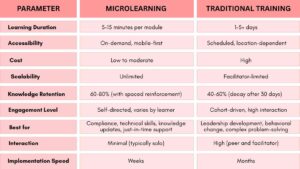
Microlearning represents a fundamental reimagining of how knowledge is delivered in the digital age. At its core, microlearning delivers focused, bite-sized learning content designed to be consumed in short bursts—typically between 5 and 15 minutes.
Unlike traditional training that assumes learners have a dedicated block of time, microlearning adapts to how people actually work and learn. It’s:
- Mobile-first: Accessible on smartphones, tablets, and laptops
- On-demand: Available whenever the learner needs it—at 9 AM or 9 PM
- Focused: Each module targets one specific skill, concept, or competency
- Modular: Standalone units that don’t require prerequisite knowledge
- Engaging: Interactive formats that leverage gamification, video, quizzes and real-world scenariosCommon microlearning formats include short-form videos (60–120 seconds), interactive quizzes, infographics, mobile apps, push notifications, and just-in-time performance support tools. The content is typically designed for immediate application—”I need to know this now to do my job better today.”
What is Traditional Training?
Traditional training represents the established model of corporate learning: structured, instructor-led programs delivered in dedicated time blocks, typically in classroom or workshop settings.
Traditional training thrives on immersive, comprehensive learning experiences. A typical program might span a few days to several weeks, with cohorts of learners engaging face-to-face with experienced facilitators who can adapt, observe, and respond to the group’s real-time needs. It includes leadership programs, soft skills workshops, technical certifications, and behavioral change initiatives.
Key characteristics include:
- Instructor-led expertise: Real facilitators who bring experience, nuance, and adaptability
- Cohort learning: Peer interaction, networking, and collaborative problem-solving
- Immersive depth: Extended time to explore complex topics, case studies, and practical applications
- Structured progression: Designed learning journeys with clear outcomes and accountability
- Relationship-building: Mentoring, feedback, and personal coaching opportunities
Microlearning: Key Benefits & Limitations
Benefits
Flexibility & Accessibility: Learners control when and where they engage. No need to block off two days for training—employees learn during commutes, lunch breaks, or quiet moments.
Higher Retention Rates: Research suggests spaced, focused learning (the microlearning model) improves long-term retention by up to 80% compared to massed training. Reinforcement through multiple small exposures is psychologically proven.
Cost Efficiency: Lower development and delivery costs. Microlearning modules are faster to develop, require less instructor time, and scale effortlessly across thousands of employees.
Scalability: Deploy identical content to 100 or 100,000 people simultaneously. Perfect for global organizations with distributed teams.
Measurable Engagement: Digital platforms provide granular data on who completed what, when, and how well—critical for demonstrating L&D impact.
Limitations
Shallow Learning: Microlearning excels at knowledge transfer but struggles with complex, interdisciplinary topics that require exploration, debate, and critical thinking.
No Behavioral Change at Scale: While microlearning is effective for “what” and “how,” deep behavioral transformation—especially in leadership—requires sustained engagement and reflection that short bursts can’t facilitate.
Learner Isolation: No peer interaction, no facilitator feedback, no collaborative problem-solving. Isolation can reduce motivation for self-directed learners.
Context Blindness: Microlearning modules don’t always account for organizational culture, team dynamics, or nuanced business scenarios that require expert interpretation.
Traditional Training: Key Benefits & Limitations
Benefits
Deep Skill & Knowledge Development: Complex subjects—strategic thinking, transformational leadership, advanced technical skills—demand immersive, guided exploration that only extended training provides.
Behavioral & Cultural Transformation: Leadership programs and organizational change initiatives work because they create sustained reflection, peer accountability, and emotional engagement—impossible in five-minute videos.
Networking & Relationships: Cohort-based learning builds professional networks, mentoring relationships, and organizational cohesion. These networks often outlast the training itself.
Adaptive Facilitation: Experienced facilitators read the room, adjust content, answer unexpected questions, and challenge assumptions—human intelligence that algorithms can’t replicate.
Higher Perceived Value: Extended, in-person training signals organizational investment and often carries greater credibility with participants.
Limitations
Time & Logistical Burden: Pulling employees from operations for multi-day programs disrupts business continuity and requires complex scheduling, especially for global organizations.
High Costs: Instructor fees, venue rentals, travel, accommodation, and production costs make traditional training expensive.
One-Size-Fits-All Risk: Cohort-based learning may not account for individual learning styles, prior knowledge, or role-specific needs.
Retention Decay: Without reinforcement, knowledge from traditional training drops significantly after 30–60 days. The “training spike” fades fast without follow-up.
Slower Scaling: Training is limited by facilitator availability and scheduling. Rolling out a leadership program globally takes months, not weeks.
Microlearning vs Traditional Training: Quick Comparison
Which Works Best for Organizations Today?
Here’s the insight that transforms L&D strategy: the question “microlearning vs traditional training?” is the wrong question.
The right question is: “What business problem are we solving and which learning approach—or combination—will create measurable business impact?”
A compliance update? Microlearning wins.
A sales team needing a quick product knowledge refresh? Microlearning.
A C-suite leader struggling with strategic decision-making in a volatile market? Traditional leadership training.
A technical team facing a complex system redesign? A blend of both.
The Blended Learning Advantage
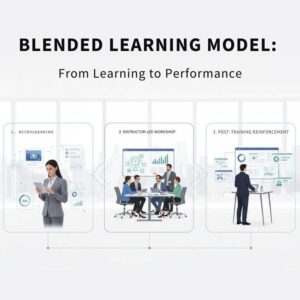
The organizations achieving the highest employee engagement and business outcomes aren’t choosing one approach—they’re designing blended learning ecosystems that leverage both strategically.
A blended approach might look like this:
- Pre-work microlearning: Employees engage with foundational content before an in-person workshop
- Immersive workshop: A multi-day program where facilitators build on this foundation, enabling deeper discussion and behavioral work
- Post-training reinforcement: Microlearning modules delivered over 30–60 days to reinforce key concepts and drive application
This structure maximizes retention (by 40–50%), accelerates behavioral change, and ensures employees apply learning on the job—the ultimate measure of training effectiveness.
Mentora India’s Strategic Perspective
At Mentora India, we’ve spent years designing and delivering learning transformations across India’s most ambitious organizations. Our experience confirms one truth: generic learning solutions don’t drive business results. Bespoke, role-based, outcome-focused programs do.
We don’t believe in microlearning or traditional training. We believe in learning architectures that are built for your specific organizational challenges, industry dynamics and talent aspirations.
What sets us apart:
- Business-driven design: Every program maps directly to organizational strategy and measurable outcomes
- Role-based personalization: Content and delivery adapted to learner context, seniority and development needs
- Facilitator excellence: Our facilitators combine subject expertise with emotional intelligence, creating transformative learning experiences
- Integrated technology: Platforms that make microlearning contextual, measurable and connected to performance
- Accountability: Pre-program baselines, mid-program check-ins and post-program impact measurement
Conclusion: The Future of Corporate Learning
The future of corporate learning isn’t about choosing between microlearning and traditional training. It’s about designing intelligent, integrated learning journeys that combine the best of both worlds—the accessibility and scalability of microlearning with the depth and transformative power of immersive experiences.
As business transformation accelerates, as roles evolve faster than ever, and as competitive advantage increasingly hinges on organizational capability, the organizations that win will be those that invest in learning strategically—not as a compliance checkbox, but as a core driver of business performance.
Whether you’re scaling compliance training across 10,000 employees, developing your next leadership cohort or building a learning culture that attracts and retains top talent, the question isn’t which approach works best. The question is: what does your organization need to achieve and how can we design a learning strategy that gets you there?
That’s where the real transformation begins.
📌 Frequently Asked Questions (FAQs)
1. What is microlearning in corporate training?
- Microlearning is a training approach that delivers focused, bite-sized learning content—typically 5–15 minutes—designed for on-demand, mobile-first consumption. It targets specific skills or knowledge points and is often used for compliance, product updates, soft skills reinforcement and just-in-time performance support.
2. Is microlearning more effective than traditional training?
- Not universally. Microlearning excels at knowledge transfer and retention when content is focused and reinforced over time. However, traditional training is often more effective for complex topics, behavioral change and leadership development. The most effective approach combines both strategically.
3. When should organizations use traditional training?
- Traditional training is ideal for: leadership development, organizational culture and values work, complex technical or strategic topics, behavioral transformation, team building and programs where facilitation expertise and peer interaction are critical to outcomes.
4. Can microlearning replace classroom training completely?
- While microlearning can supplement and reinforce classroom training, it cannot fully replace it for complex skill development or cultural transformation. Organizations achieve the best results with hybrid approaches.
5. What is blended learning?
- Blended learning integrates microlearning and traditional training into a cohesive program. Employees might complete microlearning modules before a workshop, engage in immersive in-person training, then reinforce learning through post-training digital modules—maximizing engagement, retention and business impact.
6. How does Mentora India design learning programs?
- Mentora India starts with business strategy and organizational challenges, then designs customized learning architectures that may include microlearning, traditional workshops, coaching and technology platforms. Our approach is always role-based, outcome-focused and measurable.
7. How do you measure training effectiveness?
- Effective measurement includes: participant satisfaction, knowledge acquisition (pre/post assessments), behavioral application on the job, team performance metrics and ultimate business impact (productivity, revenue, retention, etc.). Digital platforms provide real-time insights into microlearning engagement and completion.
